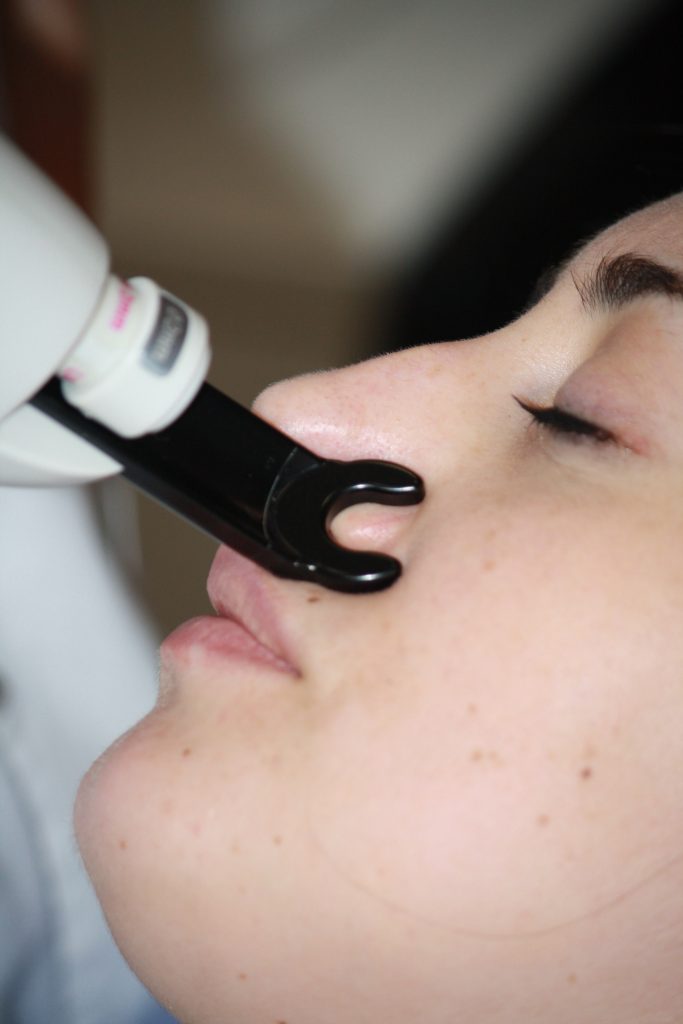
Superficial veins, depending on the diameter, can be treated with sclerotherapy or with the LPlaser.
For veins larger than 2-3 mm in diameter, sclerotherapy is recommended, while for smaller veins, LPlaser treatment is more effective. This laser is suitable for all skin types.
In the case of the laser, up to 6 sessions may be required for complete elimination of capillaries.
The treatment is relatively painless, with only a slight pinching sensation when the vessel is targeted.
Removing cosmetic tattoos, such as eyebrow tattoos, with the Q-switched Nd
laser is a medical procedure that uses a special type of laser to break down the tattoo pigment beneath the skin, gradually fading or completely removing it. This laser can break down the tattoo colors into small fragments, which are then removed by the body’s immune system.
This procedure uses an intensified laser light to target the tattoo pigment in areas like the eyebrows. During the treatment, the laser light is directed towards the tattoo area, breaking down the pigment into small fragments. These fragments are gradually removed from the body during the healing process, leading to the fading or removal of the tattoo.
Sunspot removal with the KTP (Potassium Titanyl Phosphate) laser is an aesthetic procedure that uses a specialized laser to eliminate or reduce sun spots caused by sun exposure on the skin’s surface. The KTP laser works in the green light spectrum and is effective for treating sun spots and other skin damage resulting from sun exposure.
This process helps break down excess pigment beneath the skin, causing it to fade gradually or be completely eliminated. Furthermore, KTP laser treatment can also help improve the skin’s texture and reduce the signs of aging.
Rosacea is a chronic skin disorder characterized by redness, primarily on the cheeks, nose, between the eyebrows, and chin.
Vascular laser treatments target the hemoglobin pigment, causing the closure of blood vessels. This reduces redness and the skin’s reaction to triggers such as temperature changes, drinking wine, or emotional triggers (flushing).
In just a few sessions and with a short recovery time, blood vessels are closed, and the skin color improves.
Using advanced technology, we can treat capillaries without side effects and with ideal results.
ClearSkin 1540 nm treatment for active acne is a procedure that uses a special laser to treat acne and its marks. This laser works on the surface level of the skin, helping to reduce inflammation and prevent new acne formation.
To benefit from ClearSkin 1540 nm treatment for active acne, it is important to consult with an aesthetic medical specialist to discuss options and determine if this treatment is suitable for you. As with any aesthetic procedure, it is important to understand the potential risks and benefits and have realistic expectations regarding the results.
ClearLift treatment with the Q-switched Nd laser is an aesthetic procedure that uses a laser called Nd to improve the appearance of the skin by reducing wrinkles, fine lines, aging, and other signs of aging. This technology uses powerful laser light to stimulate the production of collagen and elastin under the skin, resulting in healthier, fresher, and rejuvenated skin.
To benefit from the ClearLift Q-switched Nd treatment, it is important to consult with an aesthetic medical specialist to discuss options and determine if this treatment is suitable for you. As with any aesthetic procedure, it is important to understand the potential risks and benefits and have realistic expectations regarding the results.
One of the most common concerns in consultations is the sagging of the eyelids, whether on the upper, lower, or both eyelids simultaneously.
Using fractional CO2 laser around the eye area allows us to improve the quality of skin on the upper and lower eyelids with a short recovery time.
At the same time, this treatment improves the color and tightens the eyelids or palpebrae.
How is it different from surgery?
Laser resurfacing (resurfacing) is not a surgical procedure like blepharoplasty. On one hand, this offers benefits such as shorter recovery time and excellent results without the need for surgery. On the other hand, depending on the degree of sagging of the eyelids, some patients may benefit more from surgical intervention.

Benign skin lesions are a diverse group of skin markings, including spots and small raised areas that may resemble hair follicles or growths on the skin’s surface. In some cases, these benign lesions may cause aesthetic concerns, especially when they appear in visible areas of the face or body. CO2 laser treatment is an option for reducing these lesions, making them less noticeable or even removing them entirely.
The procedure for eliminating benign lesions with the CO2 laser uses a specialized type of laser that targets the lesions on the individual’s skin. After the treatment, the treated area may appear slightly red but will continue to improve during the recovery period.
Laser blepharoplasty is a modern surgical procedure that uses laser technology to address aesthetic or functional concerns of the eyelids and surrounding areas. Compared to traditional blepharoplasty, it offers several key advantages. The laser allows for more precise corrections with minimal tissue damage and significantly reduced bleeding. Recovery time is typically shorter, enabling patients to return to their daily routines more quickly.
Additionally, the procedure results in less inflammation and discomfort during the healing process. The high precision of the laser enables surgeons to enhance the shape and appearance of the eyes in greater detail, leading to more refined outcomes. Overall, laser blepharoplasty provides natural-looking, long-lasting results, giving the face a rejuvenated and refreshed appearance.
Vascular lesions such as angiomas, hemangiomas, “Port wine” stains, or salmon spots can be treated with vascular laser.
The vascular laser specifically targets the red pigment in hemoglobin, causing spasms and closure of the small capillaries within the vascular lesion.
Vascular lesion treatment is done in several comfortable sessions with a short recovery time.
◦ Lip remodeling
◦ Nose remodeling
◦ Chin remodeling
◦ Ear remodeling
◦ Nasolabial remodeling
◦ Skin biorevitalizers
◦ Injections under ultrasound
Treatment of acne scars is carried out through combined protocols, with the main treatment being resurfacing with fractional CO2 laser.
The recovery time for acne scars is usually 4-6 days. Results can begin to be noticeable after 6 weeks, but full changes may take 2-3 months.
The number of sessions required depends on the depth and size of the scars, the area being treated, and individual regenerative capacity.
During the consultation, a close examination is done, and the treatment protocol is determined.
Angioma treatment with LP Nd laser is a medical procedure that uses a special laser to eliminate or reduce the dark color of these skin conditions. Angiomas are a type of expanded veins on the surface of the skin, which are often red or dark red in color. These expanded veins can appear anywhere on the body but are most common on the face, legs, and chest.
The LP Nd laser treatment is effective because the laser can destroy the black pigment in the blood inside the enlarged veins, making them fade gradually or completely disappear. This procedure is relatively painless, and patients usually do not need long recovery times. Results can usually be seen